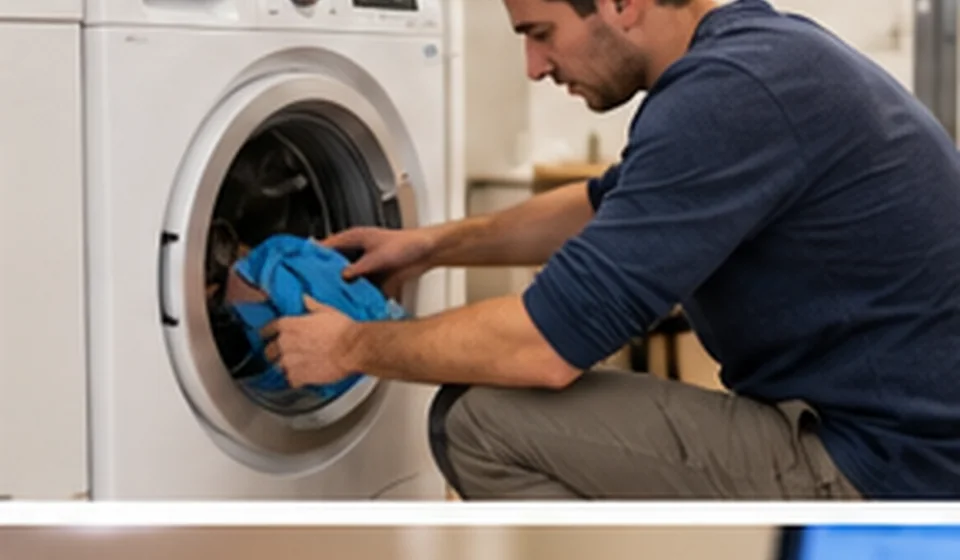
When the washing machine breaks, the cost shows up straight away: trips to the launderette, coins for every load, school uniforms that will not dry in time, and for some households bedding or clothes that need washing daily because of a health condition or a baby. On a low income, replacing the machine can feel impossible, especially if a bank has said no or your credit file is weak.
In the United Kingdom there are several ways to get a working machine without high-cost credit: repairing the one you have, asking a local welfare fund to supply one, or applying to a charity that provides white goods. This page goes through them in the order that usually works best.
Check whether it can be repaired first
Many breakdowns are cheaper to fix than people expect: a blocked filter, a worn door seal, a faulty pump or broken carbon brushes. Before you buy anything:
- Clean the pump filter and check the hoses; the manual or the manufacturer's website often explains how.
- Look for the purchase receipt: the machine may still be under the manufacturer's guarantee, and the Consumer Rights Act can help if a fairly new machine has failed early.
- Check whether you pay for an extended warranty or appliance cover, possibly through your bank account or home insurance.
- If you rent a furnished home and the machine came with it, it is normally the landlord's responsibility to repair or replace it.
- Ask for a quote from a local repairer, and compare it with the cost of a replacement before agreeing.
Community repair cafés and some housing associations' tenancy support teams can also help with simple faults.
Local welfare funds that may provide a machine
Crisis help from councils and devolved governments often comes as goods rather than cash, and a washing machine is one of the items they most commonly supply. The names differ across the UK:
- England: local welfare assistance or hardship schemes run by your county or unitary council. Some councils also use money from national hardship funding to provide appliances.
- Scotland: the Scottish Welfare Fund, whose Community Care Grants can help people set up or stay in their home, including with essential appliances.
- Wales: the Discretionary Assistance Fund, which can provide household items through its Individual Assistance Payments.
- Northern Ireland: Discretionary Support, which can offer grants or interest-free loans.
Explain clearly why the machine is essential: children in the household, a disability, incontinence, a medical need for frequent washing, or long distances to a launderette. A support worker, health visitor or social worker can strengthen the application. Our wider page on help with essential household appliances covers cookers and other white goods.
Benefit advances and loans from the state
If you receive Universal Credit and have been claiming for a while, a Budgeting Advance can cover a household item such as a washing machine. It is interest-free and repaid through deductions from your later payments, so check you can manage with a lower award for those months. People still on older benefits or Pension Credit may be able to apply for a Budgeting Loan instead. Neither is a grant, but both are far cheaper than commercial credit.
Charities and grants for white goods
A number of charities fund or supply household appliances to people on low incomes. The best starting point is a grant search tool such as the one run by Turn2us, which matches you with funds based on your circumstances, past occupation or area.
Families with children
Families raising a disabled or seriously ill child may be able to apply to the Family Fund, which provides grants for items including washing machines. Local family support charities and school welfare officers sometimes know of small funds too.
Occupation and service charities
Benevolent funds linked to particular trades, professions and the armed forces often help former workers and their families with essential appliances.
Reuse and furniture projects
Furniture reuse charities sell tested second-hand or refurbished machines at low prices, and some provide them free on referral from a council or support agency. Ask whether delivery, installation and removal of the old machine are included, because those can add noticeably to the cost.
Cutting laundry costs while you wait
Applications can take days or weeks. In the meantime, a few habits keep costs down: run full loads at the launderette, choose service washes only when drying is the real problem, hand-wash small items, and ask friends or family to share a machine for bulky loads. Some community centres and schools run free or low-cost laundry projects. When you do get a machine, an efficient model and lower wash temperatures will reduce your energy and water bills; see our guide on help with water bills if those are also stretched.
If you have to buy on credit
Only consider borrowing once grants, welfare funds and repair have been ruled out. Compare the APR and the total you will repay, not the weekly price.
- Credit union loan: usually the most affordable option for people with a thin or poor credit file.
- Rent-to-own shops: the Financial Conduct Authority capped rent-to-own prices in 2019, but the total cost can still be well above the shop price, often with insurance added. Read every line of the agreement.
- Catalogue credit and buy now pay later: easy to approve, but missed payments add charges and can damage your credit file.
- Payday loans: rarely suitable for an appliance, because the repayment comes all at once.
Our page on interest-free loans explains where zero-interest borrowing really exists.
Avoid these scams
- Social media sellers offering brand-new machines at prices far below the market, asking for payment by bank transfer.
- "Lenders" who promise approval regardless of credit history but ask for a fee upfront.
- Fake grant websites that charge to "process" an application to a charity or council, which is always free.
Step-by-step check-list
- Check the guarantee, warranty or landlord's responsibility.
- Get a repair quote.
- Apply to your local welfare scheme, explaining why the machine is essential.
- Ask about a Budgeting Advance or Budgeting Loan if you receive benefits.
- Run a charity grant search and contact local reuse projects.
- Borrow only as a last resort, comparing APR and total cost.
Loan offers and financial help to compare
- Family Fund — Charity offering grants to low-income families with disabled or seriously ill children for household essentials such as white goods, beds and computers.
- Good Things Foundation National Databank — Digital inclusion charity whose National Databank provides free mobile data, texts and calls through local community partners to people who cannot afford connectivity.
- Hubbub Community Calling — Environmental charity programme that collects unwanted smartphones, refurbishes them and gives them to digitally excluded people through local community organisations.
- Reuse Network — National network of reuse charities and social enterprises that supply affordable second-hand furniture and household appliances to people on low incomes.
Indicative, non-exhaustive list of real institutions, with no commercial link to this site. Check authorisation, APR and terms before applying; never pay fees upfront.